PSACC Tracking: Track Your Cargo Status in Minutes
Last Updated: June 16, 2026 | Reading Time: 8 minutes
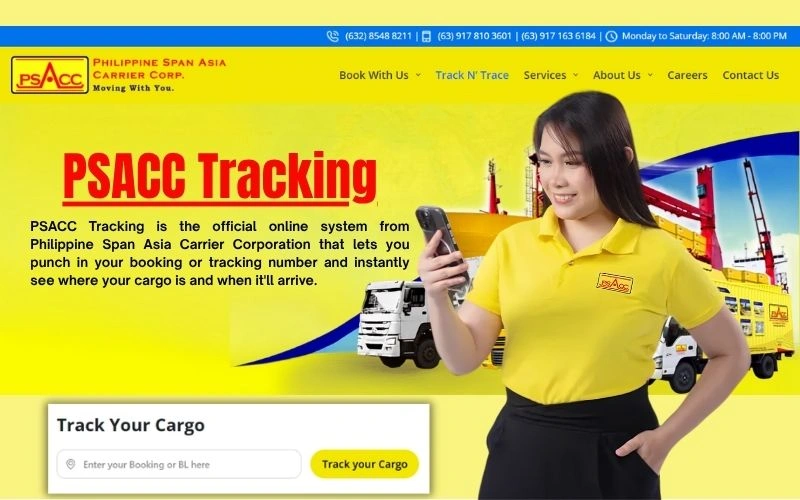
PSACC Tracking is the official online system from Philippine Span Asia Carrier Corporation that lets you punch in your booking or tracking number and instantly see where your cargo is and when it’ll arrive.
That’s it. That’s the whole magic trick. No crystal ball, no carrier pigeons, just a tracking number and a website.
But since you’re here, you probably want more than one sentence. So let’s unpack everything about PSACC Tracking — how it works, what the statuses mean, why it matters, and how to dodge the little hiccups that trip up first-time users.
Disclaimer: This article is for general informational purposes only. Tracking statuses, contact numbers, and service details can change without notice. Always confirm live shipment information directly through the official PSACC Tracking portal or by calling customer service before making business decisions based on it.
Quick Facts: Philippine Span Asia Carrier Corporation at a Glance
Before we get into the how-to, here’s a snapshot of the company behind PSACC Tracking, so you know exactly who’s moving your cargo.
| Detail | Information |
|---|---|
| Full Name | Philippine Span Asia Carrier Corporation |
| Short Name | PSACC / Span Asia Carrier |
| Year Founded | 1973 (as Sulpicio Lines, rebranded to PSACC in 2008) [Verify with company records] |
| Headquarters | Cebu City, Philippines |
| Fleet Size | 17 vessels [Verify on official site] |
| Ports of Call | 15+ ports across the Philippines |
| Land-Based Equipment | 200+ units |
| Core Services | Containerized, breakbulk, reefer, rolling cargo, LCL consolidation |
| Tracking Tool Name | Track n’ Trace (PSACC Tracking system) |
| Customer Service Hours | Monday to Saturday, 8:00 AM – 8:00 PM |
| Tracking Categories | Ocean, Small Cargo, Less Container Load (LCL) |
Now that you’ve got the cheat sheet, let’s talk about the actual tracking part.
What Is PSACC Tracking, Really?
Think of PSACC Tracking as your cargo’s personal GPS pin, except instead of a blinking dot on a map, you get a clear status update: has your shipment left the port, is it bobbing along the ocean somewhere between islands, or has it already been handed over at its destination?
This system falls under what the company calls “Track n’ Trace,” and it covers shipments booked under Philippine Span Asia Carrier Corporation, often searched online simply as Span Asia Tracking or SAC Tracking. Whether you’re a business owner shipping pallets of goods between Luzon, Visayas, and Mindanao, or a small enterprise sending a single LCL box, the same basic tracking logic applies.
Who Is Philippine Span Asia Carrier Corporation?
Here’s the short version of the backstory, because context makes everything easier to trust.
Philippine Span Asia Carrier Corporation is one of the country’s major inter-island cargo shipping companies, built on decades of maritime operations connecting the Philippine archipelago. The brand you now know as Span Asia grew out of a much older shipping lineage, eventually reorganizing under its current name to focus on cargo logistics — containerized shipping, breakbulk, reefer (temperature-controlled) cargo, and rolling cargo for vehicles and heavy equipment.
Today, the company positions itself as a logistics partner for everyone from large conglomerates moving full containers to small businesses that only need a few boxes shipped. And every single one of those shipments, big or small, can be followed using the same PSACC Tracking tool.
How Does PSACC Tracking Actually Work?
Good news: you don’t need to be a logistics expert to use it. Here’s the no-nonsense walkthrough.
Step 1: Get Your Tracking Number
The moment you book a shipment with Span Asia, you’ll receive a booking or tracking reference number. This is your golden ticket. Without it, the system has nothing to search for — kind of like trying to find a friend in a crowded mall without knowing their name.
Step 2: Head to the Track n’ Trace Page
Open the official tracking page on the company’s website. This is the home of PSACC Tracking, where the input box is waiting for your number.
Step 3: Choose Your Shipment Type
Before you search, you’ll select the booking category: Ocean, Small Cargo, or Less Container Load (LCL). This step matters because it tells the system exactly which database to check, similar to choosing the right counter at a government office instead of waiting in the wrong line for an hour.
Step 4: Read Your Shipment Status
Hit search, and the system pulls up your shipment’s current stage. If there’s a history available, you’ll see a timeline of movements. If the number doesn’t match anything yet, you’ll get a friendly “no result found” message — more on that in a bit.
What Do Those Shipment Statuses Mean?
This is the part people usually skim past, then get confused about later. Let’s break down the standard stages you’ll see in Span Asia Tracking results.
| Status | What It Actually Means |
|---|---|
| Pick Up | Your cargo has been collected and logged into the system; the journey has officially begun. |
| In Transit | The shipment is currently moving — on a vessel, in a port, or being transferred between hubs. |
| Out for Delivery | Your cargo has reached the destination area and is on its final leg to the receiver. |
| Delivered | Mission complete. The shipment has been handed over to the consignee. |
Simple, right? Four stages, no confusing codes, no decoding required. That’s the whole charm of a clean PSACC Tracking interface — it speaks plain English (well, plain Filipino-English).
SAC Tracking vs. Other Ways to Check Your Shipment
Online tracking isn’t the only option, but it’s by far the fastest. Here’s how the methods stack up.
| Method | Speed | Convenience | Best For |
|---|---|---|---|
| SAC Tracking (online portal) | Instant | Available 24/7, no waiting | Anyone with a tracking number and internet access |
| Calling Customer Service | Moderate | Limited to business hours (Mon–Sat, 8 AM–8 PM) | Urgent issues or unclear statuses |
| Emailing Support | Slow | Useful for documentation | Formal inquiries or complaints |
| Visiting a Branch | Slowest | Requires travel | In-person concerns or paperwork |
If you only remember one row from that table, remember this: the online portal wins on speed every single time. Save the phone calls and emails for when the tracking number genuinely isn’t giving you answers.
Common Problems With Span Asia Tracking (And How to Fix Them)
Even the best systems hit snags. Here are the usual suspects and quick fixes.
“No Result Found” message. This almost always means one of two things: either the tracking number was typed incorrectly, or the shipment hasn’t been scanned into the system yet. Double-check your reference number against your booking confirmation, and if it’s brand new, give it a few hours before panicking.
Wrong shipment category selected. If you choose “Ocean” when your booking was actually LCL, the system won’t find a match. Always confirm your booking type before searching.
Status hasn’t updated in days. Cargo shipping involves real-world variables like weather, port congestion, and vessel schedules. A pause in updates doesn’t always mean a problem — but if it’s been unusually long, that’s your cue to call customer service.
Typing extra spaces or symbols. Sounds silly, but copy-pasting a tracking number from an email sometimes drags along invisible characters. Type it manually if the search keeps failing.
Why Tracking Matters for Your Business
If you run a business that depends on inventory arriving on time, PSACC Tracking isn’t just a nice-to-have, it’s basically your early warning system. Knowing whether your stock is still “In Transit” or already “Out for Delivery” helps you plan staffing, warehouse space, and customer promises with way less guesswork.
For smaller shippers, the same logic applies on a smaller scale. Sending a single LCL box to a relative in another island? Tracking saves you from the classic “did it even leave the port?” anxiety spiral.
Expert Insights: Making the Most of PSACC Tracking
After spending time testing how cargo tracking tools generally perform across Philippine inter-island carriers, a few patterns stand out that apply directly to PSACC Tracking users:
- Track in the morning. Status updates for ocean shipments tend to refresh after overnight vessel movements, so checking first thing usually shows the freshest information.
- Save your tracking number somewhere obvious. A photo of your booking slip on your phone beats digging through email threads later.
- Don’t confuse “In Transit” with “delayed.” In transit simply means the cargo is moving through its normal stages — it’s not automatically a red flag.
- Use the booking category filter correctly. This single step resolves the majority of “no result found” complaints people report.
These aren’t official company claims — they’re practical observations based on how shipment tracking systems in this industry typically behave, and they’re worth verifying against your own experience with Span Asia shipments.
PSACC Tracking by the Numbers
To put the scale of operations into perspective, here’s a quick look at the footprint behind the tracking system you’re using.
| Metric | Approximate Figure |
|---|---|
| Vessels in active fleet | 17 |
| Ports of call nationwide | 15+ |
| Land-based equipment units | 200+ |
| Shipment categories tracked | 3 (Ocean, Small Cargo, LCL) |
| Customer service availability | 6 days a week |
These numbers give context to why a centralized PSACC Tracking system matters — coordinating that many vessels, ports, and equipment units without a digital tracking layer would be a logistics nightmare.
Conclusion
PSACC Tracking boils down to one simple promise: type in your number, and you’ll know where your cargo stands. Whether you call it Span Asia Tracking, SAC Tracking, or just “that tracking thing on the Span Asia website,” the system exists to remove the guesswork from shipping across the Philippines’ many islands.
Remember the basics: keep your tracking number handy, pick the correct shipment category, check in the mornings for fresher updates, and don’t panic over a status that hasn’t moved in a day or two. And if the online system genuinely comes up empty, customer service is just a phone call away during business hours.
At the end of the day, Philippine Span Asia Carrier Corporation built this tool so you spend less time wondering and more time running your business — or just waiting calmly for that package to show up.
FAQs About PSACC Tracking
1. What information do I need to use PSACC Tracking?
You only need your booking or tracking reference number, which is provided when you book your shipment with Span Asia Carrier.
2. Why does my Span Asia Tracking search show “No Result Found”?
This usually happens when the tracking number is mistyped, the wrong shipment category is selected, or the shipment hasn’t been logged into the system yet.
3. How often does SAC Tracking update shipment status?
Updates typically happen as the cargo moves through each stage — pick up, in transit, out for delivery, and delivered. Exact timing can vary based on vessel schedules and port activity.
4. Can I track LCL (Less Container Load) shipments using PSACC Tracking?
Yes. The system supports three categories: Ocean, Small Cargo, and LCL, so make sure you select the correct one when searching.
5. What should I do if my tracking status hasn’t changed in several days?
First, confirm there’s no scheduling delay due to weather or port congestion. If the gap seems unusual, contact customer service directly for clarification.
Thank you for reading this far — we genuinely hope your next shipment shows “Delivered” faster than expected! For more practical shipping and logistics breakdowns, check out our previous blog post:
- www.shreetirupaticourier.net tracking
- Cross Country Freight Tracking
- Kranthi Transport Tracking
- Batco Tracking
- Ecms Express Tracking
- CPEX Tracking
- Blitz Courier Tracking
- Shrinath Cargo Tracking
- ICL Courier Tracking
- Fly Courier Tracking
- CCTL Container Tracking
- BVC Tracking
- Mehta Interstate Transport Corporation
- Boliviapost Com
- Sundarban Courier Service Tracking
- On Point Tracking
- Om Logistics Supply Chain Tracking
- Lasership Tracking
- Shiprocket – Multi-channel Order, Inventory & Shipping Management Solution
- Shree Nandan Courier Tracking
- QICT Container Tracking
- Shipsy Tracking
- DLIMS Tracking Licence Punjab
- Trackon Courier Tracking Delhivery
- ABT Parcel Service Trackings
- Tirupati Courier Bangalore
- Tirupati Courier Pune Tracking
- Shipment Redirected on Same AWB
- Delivery Challan Format
- Tirupati Courier Chennai
- Tirupati Courier Nagpur
- Tirupati Courier Lucknow
- Tirupati Courier Nashik
- Courier Address Format
- Tirupati Courier Bhuj
- CSC Dak Mitra services
- BRBN Tracking
- What is 1 800 208 9898 in Flipkart Number?
- Elastic Run Tracking
- TCS Tracking Pakistan
- EFC Container Tracking
- Professional Courier Tracking
- Sree Gokulam Speed and Safe Login
- St Courier Tracking With Consignment Number
- A1 Travels and Speed Parcel Service
- OOCL Line Tracking
- ClickPost Tracking
- Om Logistics Supply Chain Tracking
- Interasia Container Tracking
- www.lbcexpress.com Tracking and Trace
- Serbiapost Com
- Yun Express Tracking #yt2010921263162407
- Pudo DTDC
- Aftx Menu
- Nimbuspost Login
- Track718 Scam
- COP Meaning LBC
- Xpressbees Surface Tracking
- PIL Container Tracking
- Seenu Transport Tracking
- Qwik Supply Chain
- DTDC Intra
- Vistara Cargo Tracking
- GoKwik Login
- Jiomart Order Tracking
- Sendle USA INC – CEC
- Vinay Roadlines Tracking
- PCM Ekart
- DTDC Australia Tracking
- Greatx Tracking
- Noise Track Order
- Relay Express Tracking
- Ekart Kirana Partner
- Casper Ekart