How to Avoid 20% in Hidden Costs When Shipping CNC Turned Parts Internationally
Introduction
Purchasing Custom CNC Turning Parts from worldwide manufacturers is an integral part of contemporary production. However, the last stage of the shipping process often diminishes the value. Getting great CNC Turning Parts Quotes is not enough because parts can be damaged during transport, leading to delayed projects and exceeded budgets. Such unforeseen expenses mostly occur when manufacturing and logistics are separated, resulting in incompatible solutions for Shipping of Precision Parts.
True cost control requires integrating risk management from the initial quote. Partnering with an OEM CNC Turning Services provider that masters both precision manufacturing and global logistics is key to achieving optimal total cost, quality, and timeline. The following critical stages cannot be ignored in this holistic approach.
Why Do Perfect CNC Turned Parts Get Damaged in Transit?
A part that is certified perfect on the QA bench can however fail during transit. Most of the time, damage results from the following three sources: inefficient packaging, vibration/shock that happens continuously, and changes in the environment. Basic packaging overlooks the particular requirements of transporting Custom Parts. Loose parts move around, which leads to scratches and dents. Furthermore, when transporting by sea, vibrations throughout the journey will turn the threads and assemblies into a fatigue test.
Besides that, humidity and temperature variations within containers will cause aluminum to oxidize or steel to rust. According to industry statistics, a large majority of logistics losses are preventable. This leads to a fundamental realization: effective CNC Machining Delivery is actually designed at the CNC Turning Quote stage rather than being an afterthought. Basing the decision only on the unit price while disregarding the transit planning will expose one to the risk.
How to Design Bulletproof Packaging for Precision Turned Parts
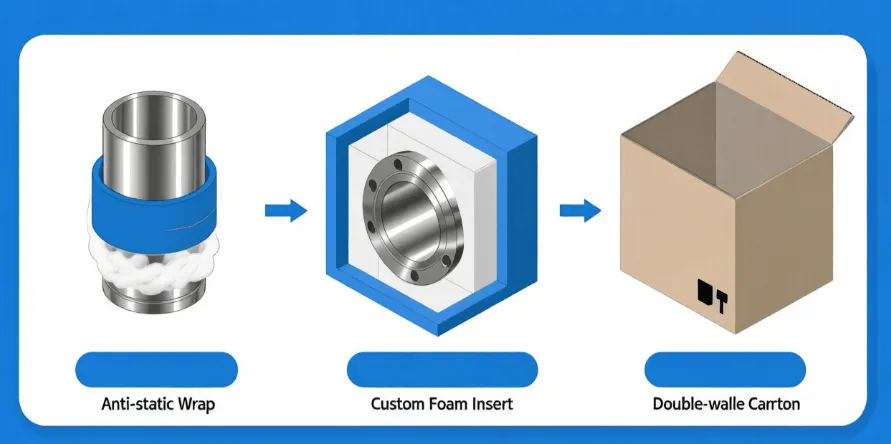
For Custom CNC Turning Parts, it is important that the packaging is a custom-engineered solution and not an afterthought.
H3: Material-Specific Protocols
Packaging of parts begins with the part itself. Aluminum parts require anti-corrosion treatments such as vacuum sealing and desiccants. Stainless steel, though corrosion-resistant, still requires anti-static wrapping for fine finishes. Coatings require material compatibility for stain-resistance.
A Multi-Layer Defense Strategy
A robust system uses layered isolation and immobilization.
- Primary Protective Layer:
Each part is individually wrapped in anti-static foam or tissue to prevent contact. - Structural Immobilization Layer:
Custom-cut foam inserts or molded trays securely hold each part in a dedicated cavity, with no movement within the master container.
Validating with Industry Standards
Expert Custom CNC Turning Services providers validate packaging against ISTA (International Safe Transit Association) standards, which simulate real transit hazards. This scientific approach, though involving a slight upfront cost, prevents far greater costs from damage. Evaluating a supplier’s packaging philosophy is crucial; a resource on evaluating such services can be found via CNC Turning Parts Quotes.
Navigating Complex Customs and Documents: How to Avoid the Nightmare of Clearance Delays?
Customs is a very critical checkpoint for CNC Turning OEM shipments. In fact, human errors in documentation form the main reason for delays, which in turn cause losses. Incorrect or unclear HS codes may lead to the misclassification of goods and consequently wrong duties being levied as well as inspections being carried out. Besides, shipping delays are also caused by commercial invoices that fail to specify the exact details of the materials, weights, or values. Apart from effortlessly assisting with the documentation, a competent OEM CNC Turning partner can provide other things such as: accurate commercial invoices with correct HS codes and the ability to issue certificates of origin or material certs on request.
Their expertise leads to a better understanding of specific country regulations, e.g. FDA or REACH compliance. Reliably documented, auditable processes are part of the package marked by the ISO 9001 certification, which in the end will really simplify your compliance task.
Air Freight, Sea Freight, or Courier? Choosing the Optimal Logistics for Your Order
Choosing the best delivery mode for CNC machining is a matter of comparing weigt-speed-cost and reliability. International courier (e.g DHL FedEx) are perfect for urgent prototypes or small batches under 100kg, as they provide door-to-door speed (3-7 days) and integrated customs at a premium. Air freight is a very good compromise and the most balanced option for medium-volume and time-sensitive production runs, with a transit time of 1-2 weeks plus handling fees. Sea freight is the most economical method for large orders, providing the lowest cost per unit.
Yet, it is very slow, takes about 20-40 days in transit and is more susceptible to delays. Also, in this case, one should use strong and weather-resistant packaging. The key thing is to use a Total Cost of Ownership (TCO) model and not just compare FOB prices. A unit cost quote that is slightly higher but offers comprehensive DDP (Delivered Duty Paid) door-to-door service can lead to a lower actual total cost than a low FOB price with complex, variable logistics fees. So when seeking CNC turning parts quotations, be sure to mention logistics options in detail and compare them. That is the main factor in cost control.
Beyond Price and Precision: What Logistics Capabilities to Scrutinize in a Supplier
A supplier’s logistics prowess is as critical as their machining tolerance. Assess these capabilities:
Execution and Service Depth
This sub-section describes the essential logistics resources and service scope that a supplier should have. It checks if the supplier has access to dedicated and vetted logistics partners for reliability and if they can offer door-to-door (DDP/DAP) service, covering transport, customs, and taxes, thereby cutting down the administrative burden for the client.
- Logistics Partnerships:
Do they have dedicated and vetted logistics partners to ensure reliability? - Service Scope:
Can they offer door-to-door service (DDP/DAP), covering transport, customs, and taxes, cutting down your administrative burden?
The Assurance of Certifications
Certifications like IATF 16949 (Automotive) and AS9100D (Aerospace) mandate rigorous supply chain and risk management processes. A certified provider’s logistics are likely systematic and traceable. Choosing a specialist in Precision Turning with integrated logistics reduces project complexity and risk.
Conclusion
Securing the safe, timely arrival of international Custom CNC Turning Parts is a systems challenge blending engineering, logistics, and risk management. The winning strategy is a holistic cost view from the start, partnering with a provider expert in both manufacturing and global CNC Machining Delivery. A partner like CNC Protolabs, which has certifications like ISO 9001, IATF 16949, AS9100D, etc., indicates that they have a management system that covers all aspects of the workflow from production to delivery. This ensures your project is not compromised in any way due to additional costs.
Author Bio
Zhang Ming is a senior supply chain and manufacturing solutions consultant who has over 15 years of experience in providing precision manufacturing services along with cross-border logistics services to high-end manufacturing customers all over the world.
FAQs
Q: How long does shipping usually take for CNC turned parts?
A: The transit time depends on various factors including origin/destination customs clearance speed, as well as the mode of logistics. For example, in a shipment from China to US/EU, if a courier service is used, it takes 3-7 days; air freight takes 5-10 days; whereas shipping via sea takes 20-40 days. It’s better to refer to the “door-to-door” estimated delivery days on your supplier’s website.
Q: How to make sure that high-gloss or tight tolerance turned parts are not scratched during transit?
A: The first step is to wrap each part in layer of anti-contact barrier materials such as anti-static tissue or polyethylene foam. Next, pack all parts in a stiff outer box using custom foam inserts to prevent parts from moving during shipping. For extra protection, consider double boxing.
Q: What percentage of the total order cost does shipping typically account for?
A: This depends on the situation a lot. For highly valuable small-batch parts, courier charges can make up 20%-30%. On the other hand, for big-volume shipments, sea freight’s proportion can be as low as 5%-10%. Estimating the logistics costs at the CNC Turning Quote stage is essential.
Q: What exactly is the content of customs clearance papers? What must the supplier offer?
A: The most important documents are commercial invoice, packing list and bill of lading or air waybill. A reliable supplier would be issuing an invoice that accurately describes the goods (indicating: material, HS code), clearly shows the value, and aside from that, he/she should be able to supply a certificate of origin for you or your freight forwarder to have a hassle-free clearance.
Q: In case that the parts have been damaged during transportation, how is liability established?
A: The matter of liability is settled by Incoterms. For instance, if the guide under FOB (Free On Board) is followed, the risk passes on to the buyer from the moment the goods are loaded on board the vessel. It is a wise step to have transport insurance and also to get acquainted with pre-shipment inspection standards (e.g. pictures, video) from the supplier so as to be able to make a claim on the carrier or insurer in the event of damage.